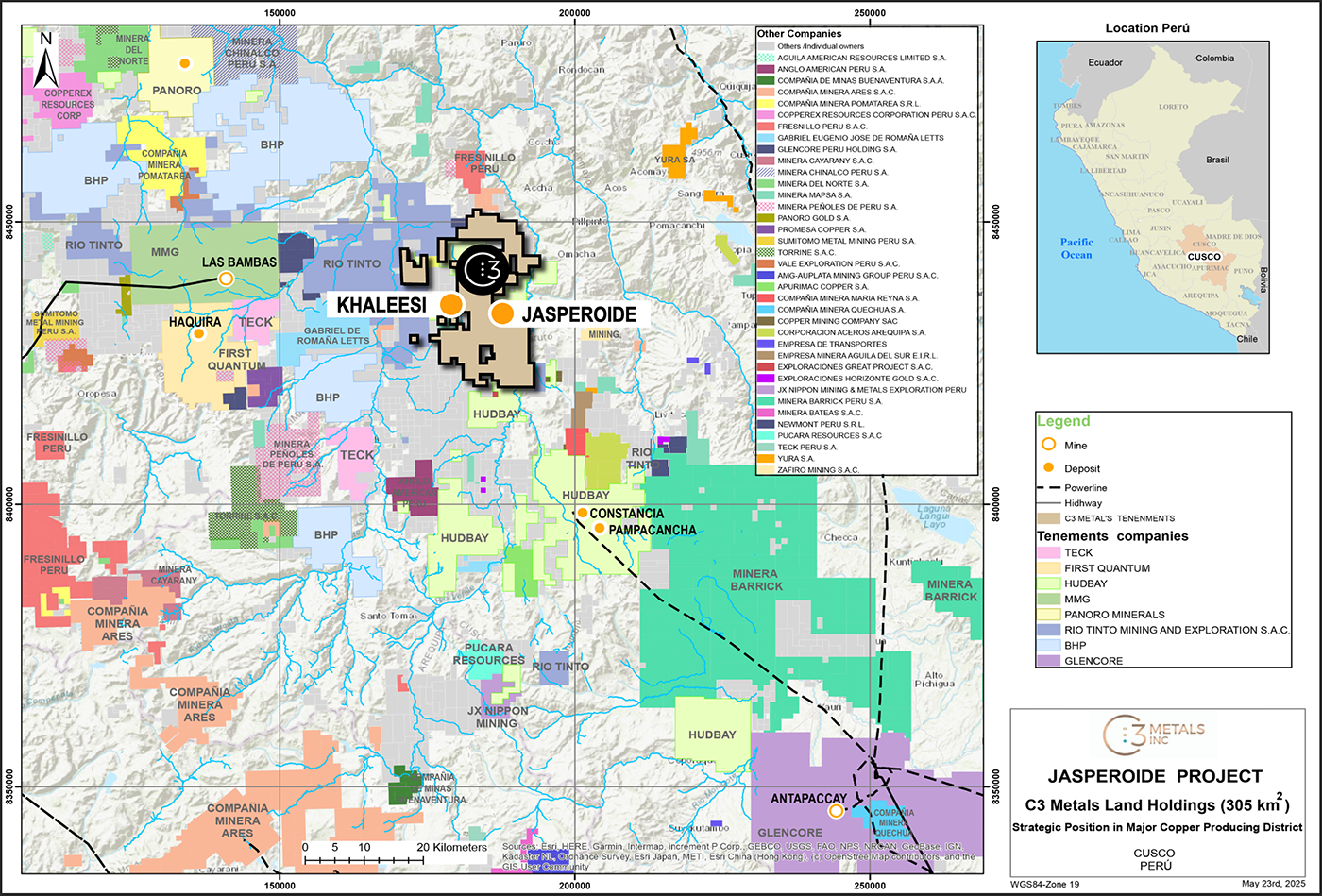
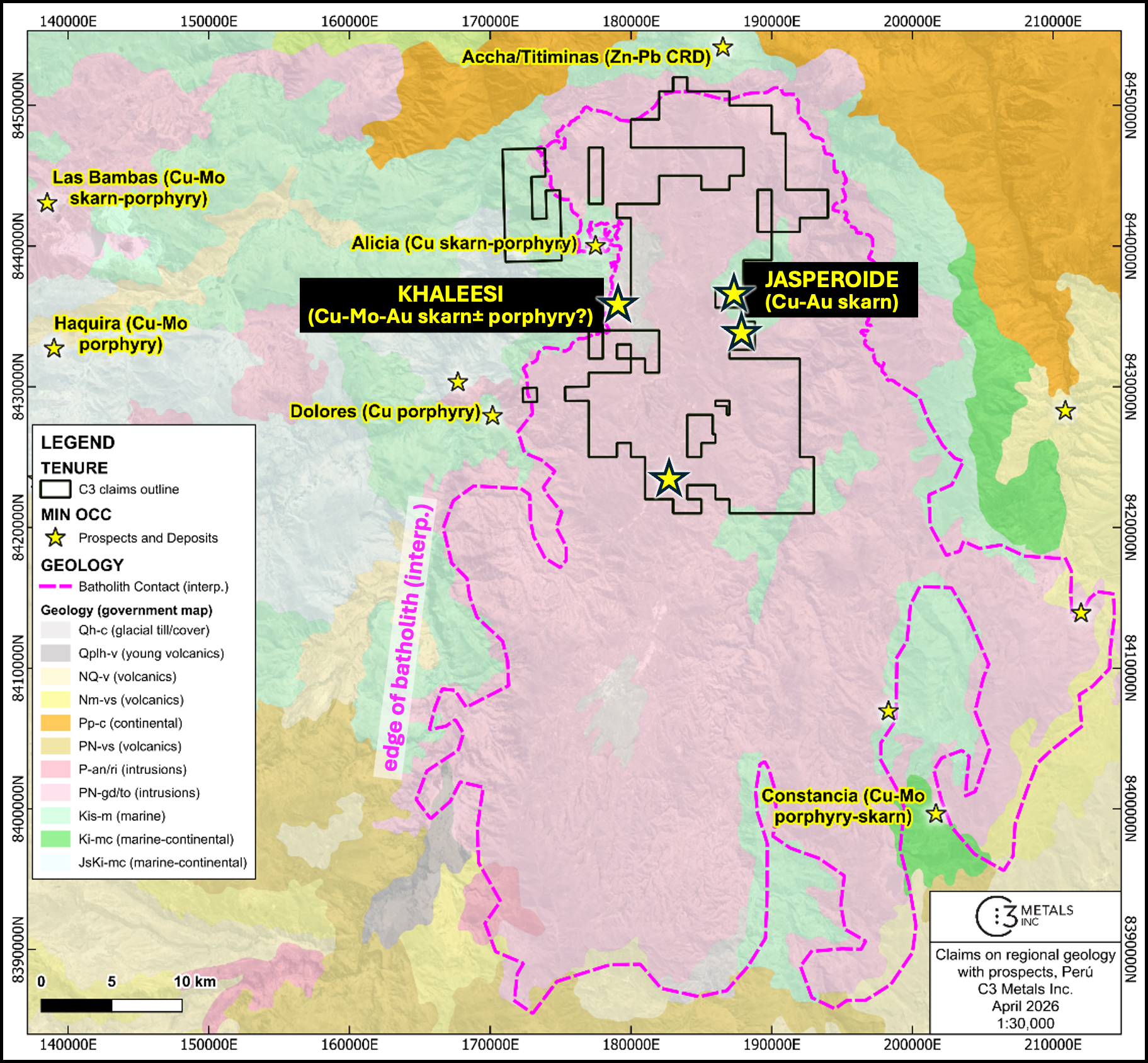
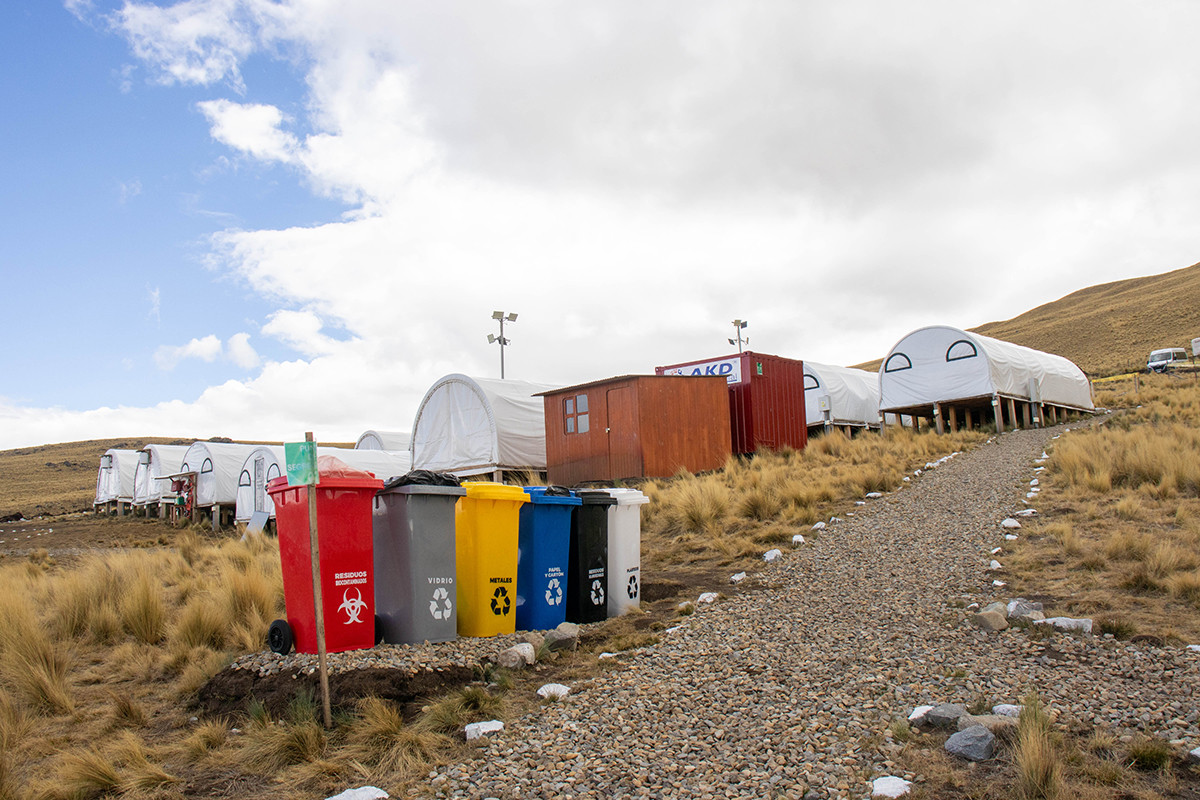
Khaleesi is a greenfield copper skarn discovery and porphyry prospect in the Andahuaylas–Yauri belt of southern Peru, ~8 km west of C3 Metals’ Jasperoide project and within 45 km of the Las Bambas (MMG) and Constancia (Hudbay) operations. C3 Metals controls ~31,000 ha in the district.
Regional map showing C3 Metals' mineral concession package in relation to other large-scale operations, development projects and exploration projects.
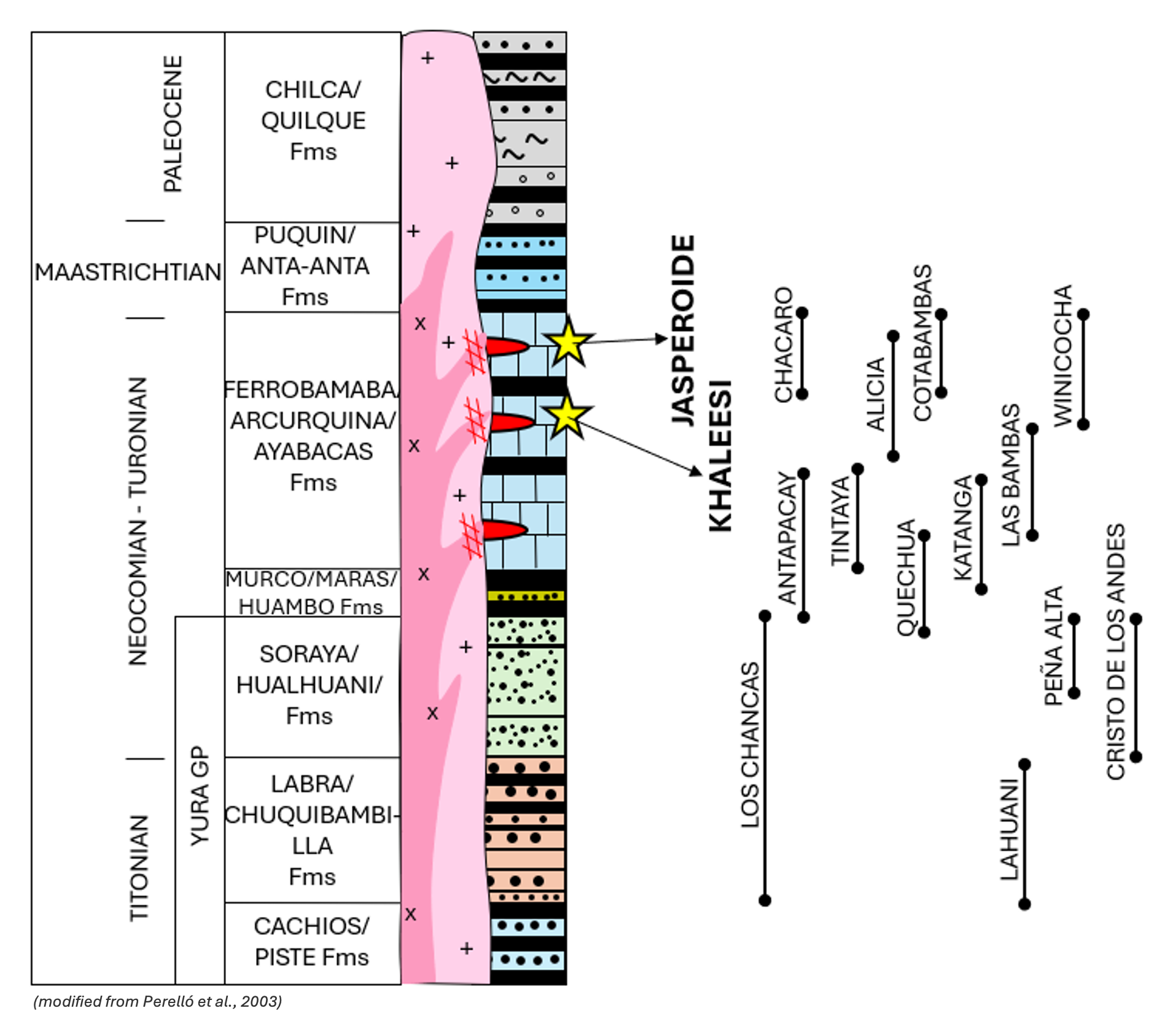
Khaleesi is situated along a highly favorable limestone-intrusive rock contact zone that bisects the tenement area and trends north-northeasterly. The limestone rock unit is part of the highly receptive Ferrobama Formation, and the intrusive rock comprises the well-known Andahuaylas-Yauri Batholith. At this contact zone is a multiphase intrusive complex that also appears to trend northeast-southwest, that follows and exploits the contact zone, which is mostly covered by a thin layer of glacial till.
History
C3 Metals staked and consolidated mineral concessions in the project area after a new road cut identified copper mineralization in diorite beneath a thin layer of glacial till cover. During 2024 and 2025, C3 Metals obtained social license through a surface access agreement with the local community, completed geological mapping, rock and soil geochemical sampling, magnetic and IP geophysical surveys and obtained an environmental drill permit for the first drill test of the Khaleesi project.
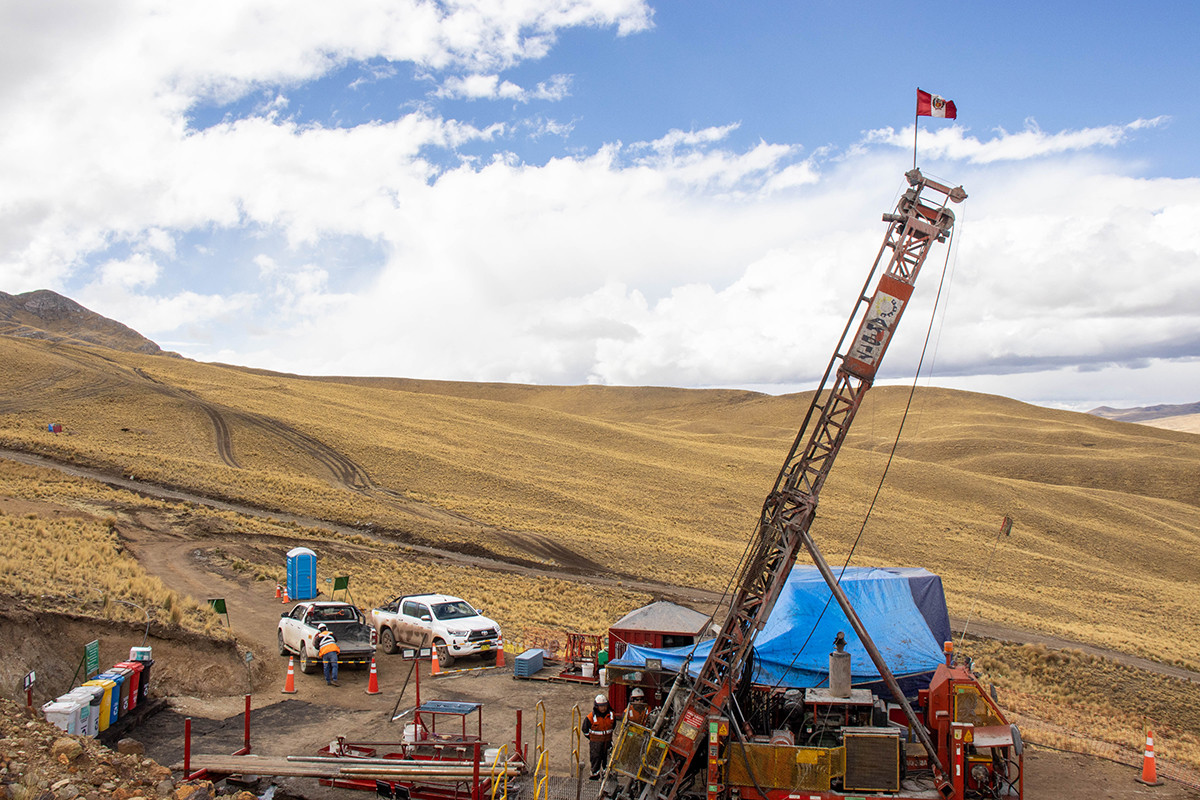
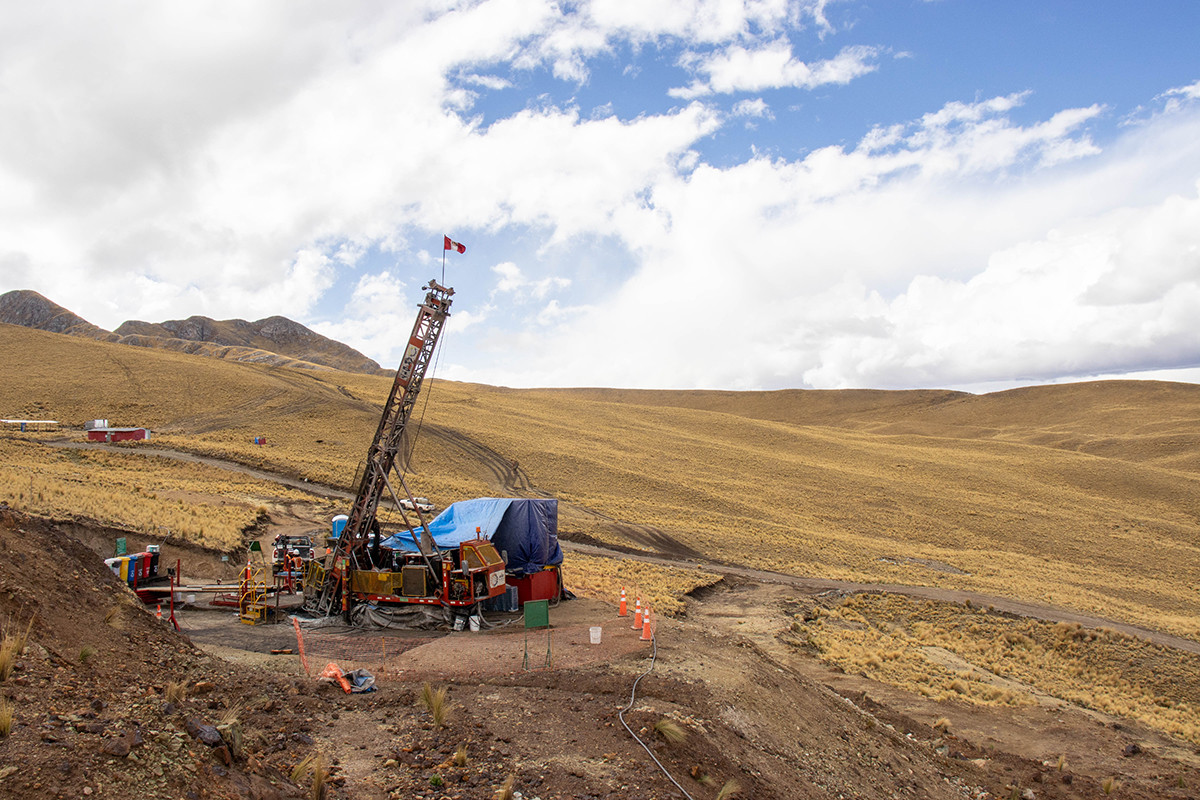
Drilling commenced during the fourth quarter of 2025 and a maiden 12-hole, 6,300m Phase 1 drill program was completed in early 2026.
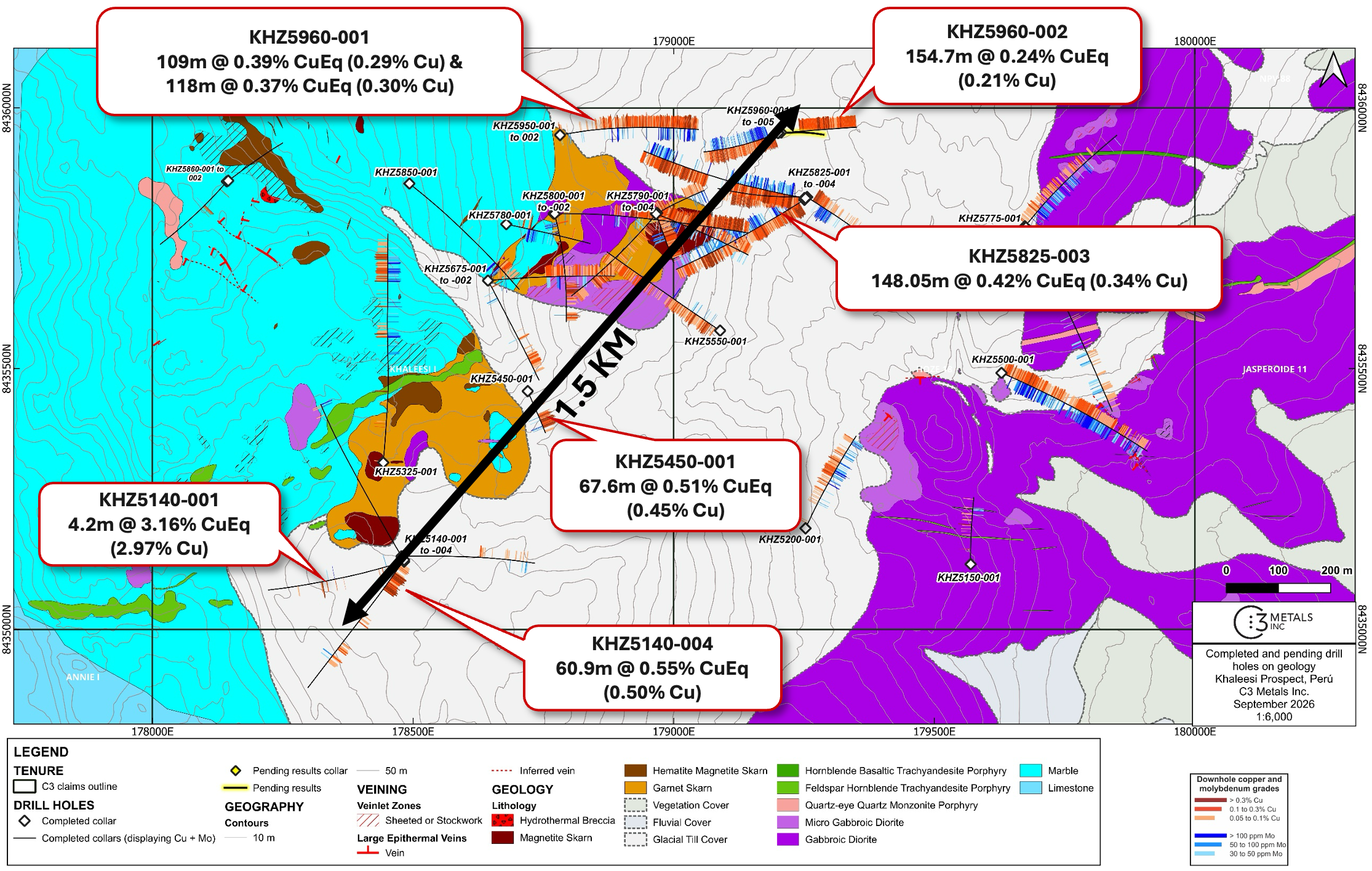
Copper mineralization was intersected in all 12 holes (See PR April 29, 2026). Drilling confirmed two styles of mineralization: near-surface intrusive hosted copper-gold-silver-molybdenum mineralization beginning within 5 to 50m depth and garnet and magnetite skarns, hosting copper mineralization. As at September 2026, the mineralized area has been defined from near surface to a vertical depth of 500+m and is over 500m in east-west dimensions. The mineralizated zone remains open to the east, west and north.
A Phase 2 program of up to 15,000m is currently underway.
Recent Exploration Program Highlights:
Phase 1 program complete: all 12 holes confirmed copper mineralization. (See PR April 29, 2026)
Secondary copper species in a near-surface enrichment zone within the multi-phase intrusive complex;
Primary low to moderate chalco-bornite-molybdenite mineralization in the intrusive complex below the enrichment zone;
Chalcopyrite-bornite-molybdenite mineralization in garnet, pyroxene and magnetite skarns;
High-grade, mantos-style copper mineralization; and
Narrow intermediate-sulphidation epithermal veins hosting based and precious metal mineralization.
System open in at least three directions: north, east, and west remain untested by drilling. (See PR Sept. 17, 2026)
New anomaly discovered 2km northeast: geophysical surveys identified a new high-priority anomaly beyond the current drill footprint. (See PR Sept. 17, 2026)
Geophysics expanded to 1,500 ha: modified DIA anticipated Q4 2026 to unlock additional high-priority drill targets. (See PR Sept. 17, 2026)
Geochronolical age date within a broad range of 39.5 ± 1.1 to 28.7 ± 0.8 Ma: same as the Large Las Bambas and Antapaccay Copper Deposits. (See PR Mar. 9, 2026)
During 2026, additional magnetic and an initial gravity geophysical surveys were undertaken to provide valuable drill targeting data for the magnetite skarns, where copper grade has typically been elevated above intrusive-hosted mineralization.
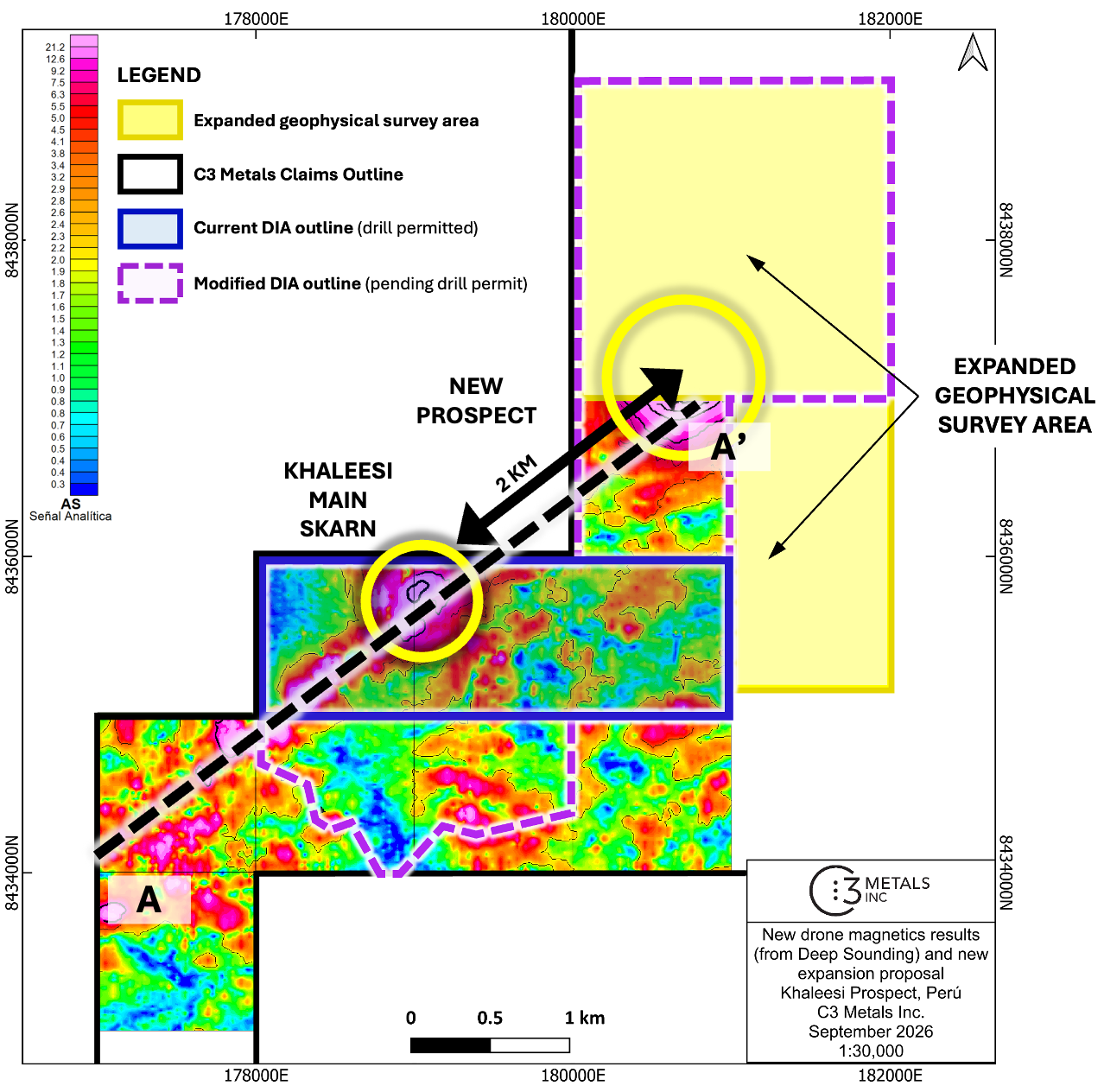
The results from these surveys correlate well with the now-confirmed mineralized skarns and delineated a new high-priority anomaly approximately 2 km northeast of the current drill area. (See PR Sept. 17, 2026)
Plan view of drone magnetic image over the Khaleesi Project showing the expanded area for the ongoing geophysical surveys in yellow. Note the blue border and the purple dotted border outlines, which represent the current drill permitted area and the modified drill permit area, respectively.
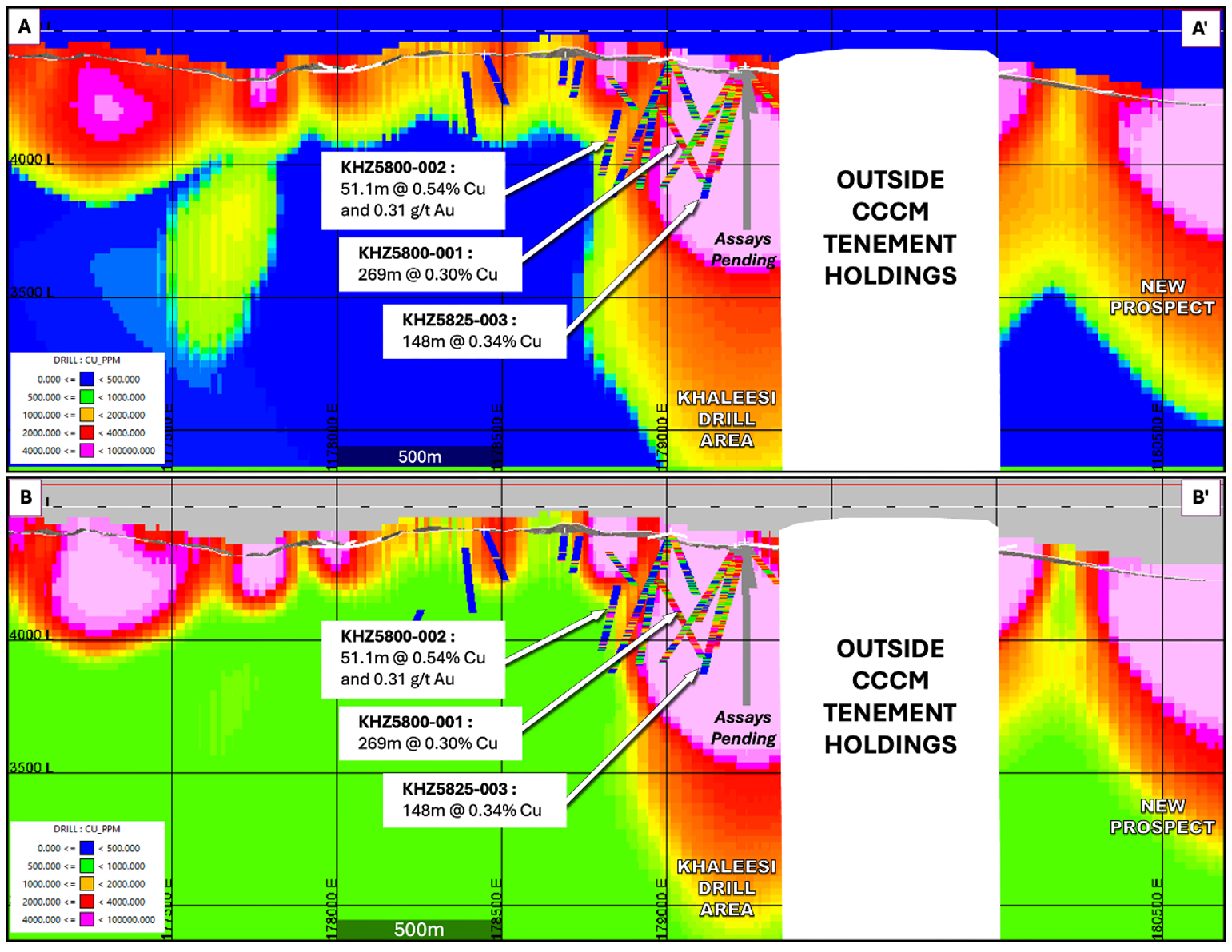
Cross section through the 3D magnetic inversion model A-A' shows the two large scale and deep-rooted magnetic anomalies at the main Khaleesi drill area and a new prospect approximately 2km to the northeast. (Bottom) Cross section through the 3D gravity inversion model B-B' shows the two large scale and deep-rooted gravity anomalies at main Khaleesi drill area and a new prospect approximately 2km to the northeast.
Drilling Program
Phase 1 — Complete
C3 Metals' maiden drill program at Khaleesi consisted of 12 holes totalling approximately 6,300m across multiple target areas. The program was designed to test the near-surface skarn potential identified in initial geophysical and geochemical surveys.
12 holes completed, ~6,300m drilled
Copper intersected in all 12 holes
Near-surface intrusive hosted mineralization (from ~5m to 50m) and skarn mineralization to a depth of 500m+
The Phase 2 drilling program is designed for up to 15,000m and will systematically follow up on on Phase 1 results, expand on new skarn discoveries, and test the northeast anomaly identified through expanded geophysical surveys. A Modified Environmental Impact Assessment (MDIA) is anticipated to be received during Q4 2026, which will increase the drill permit area substantially and allow for drill testing of additional high-priority drill targets.
Up to 15,000m planned
Follow-up step-out drilling with the goal of expanding mineralization intersected in higher-grade Phase 1 intervals.
Step-out testing of open zones (north, east, west)
NE anomaly (2 km from current drilling) to be tested pending MDIA
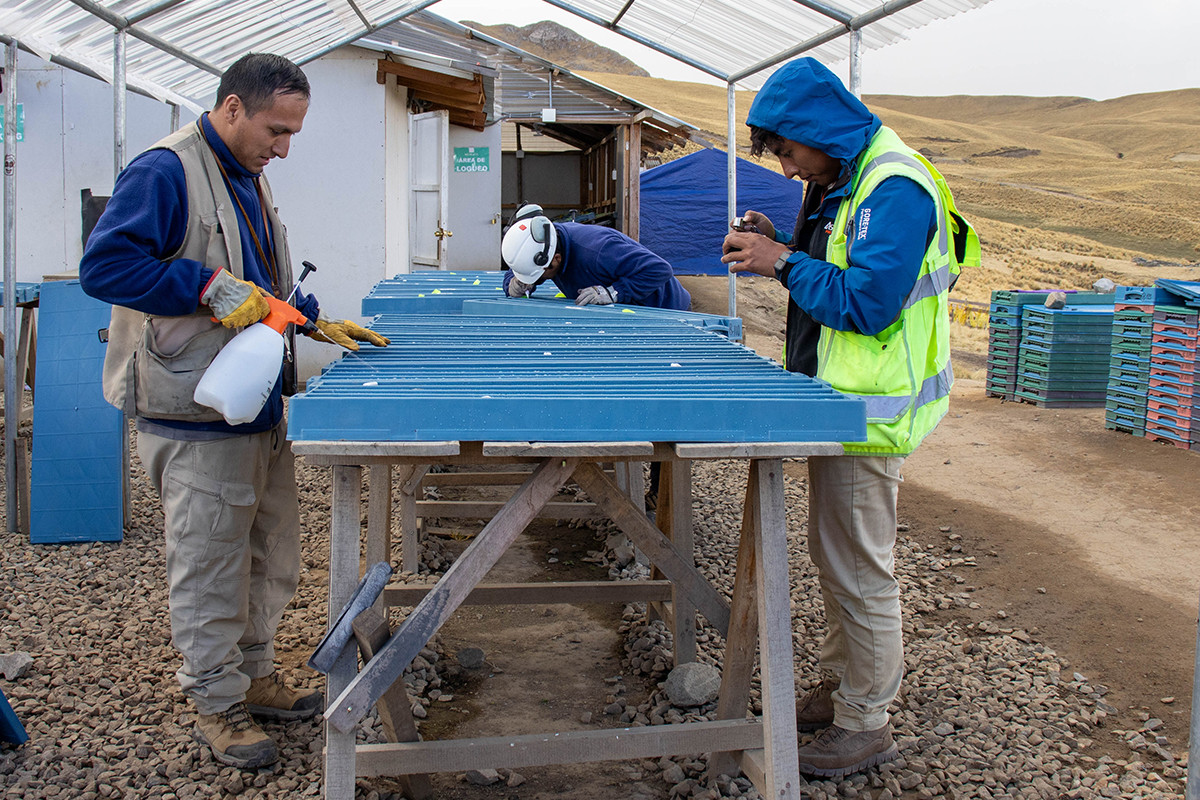
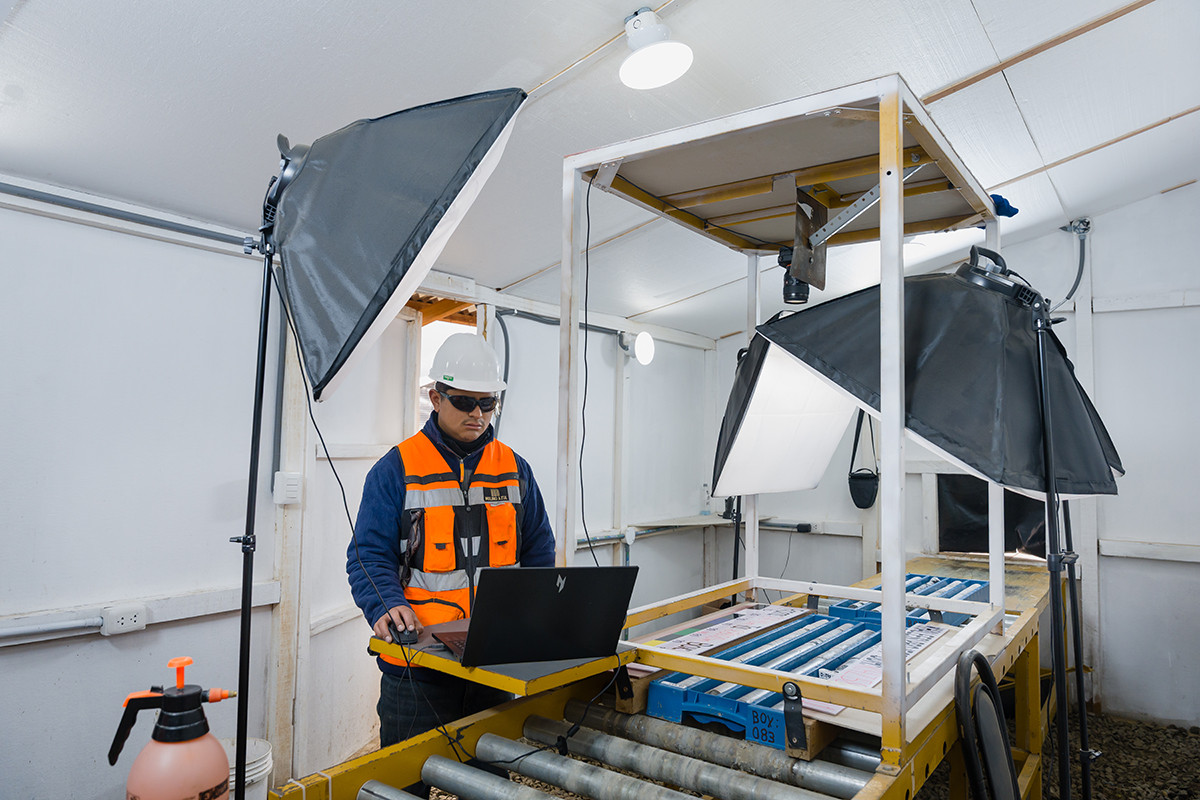
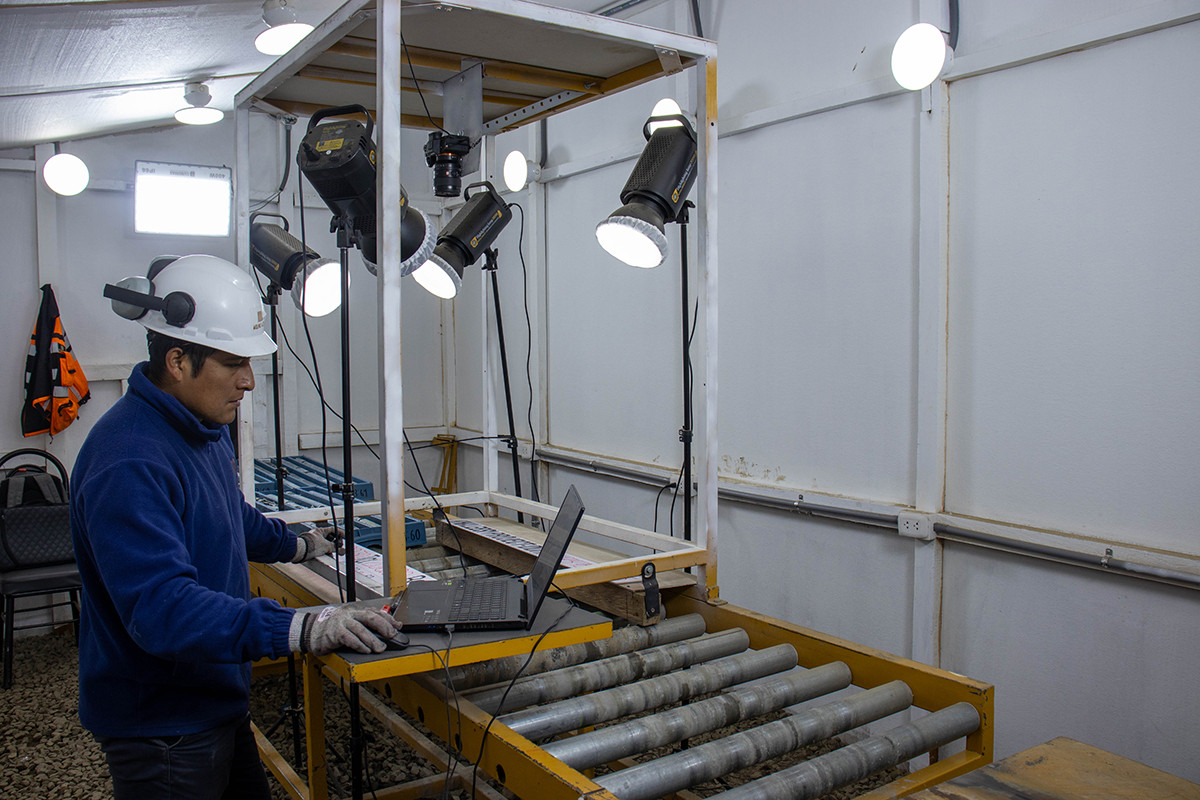
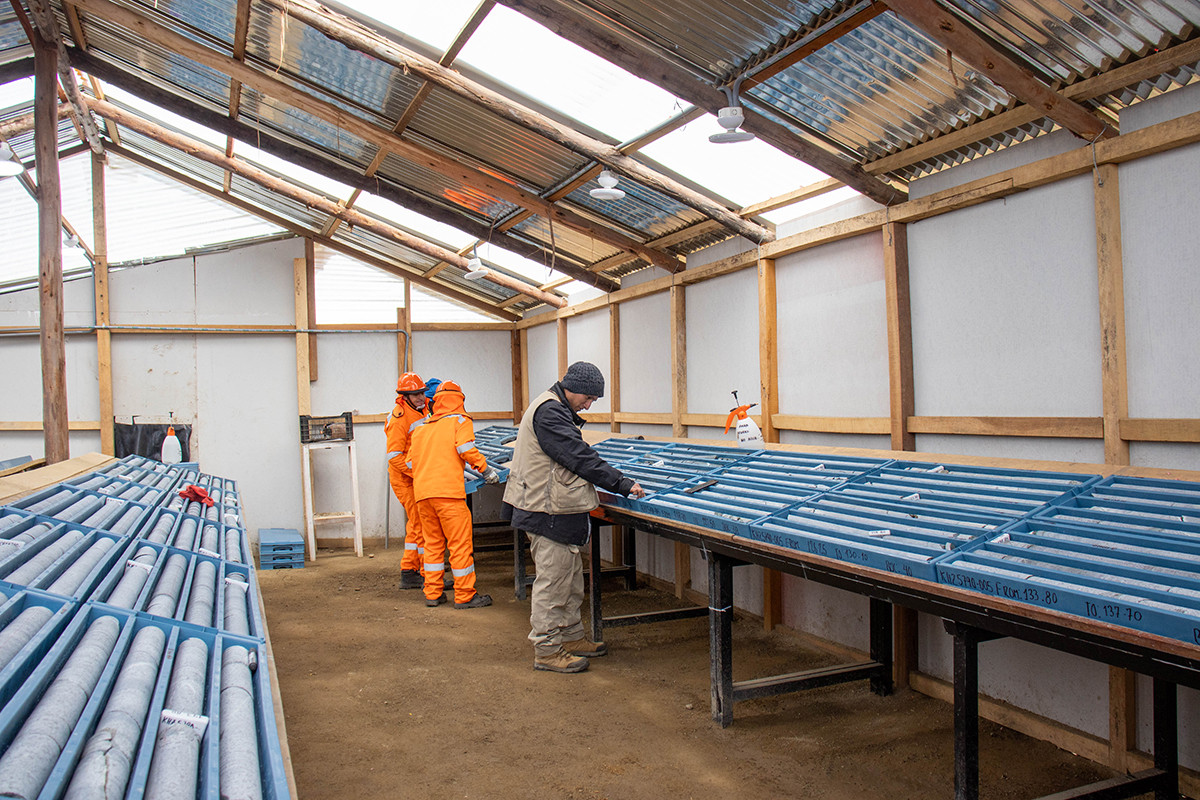
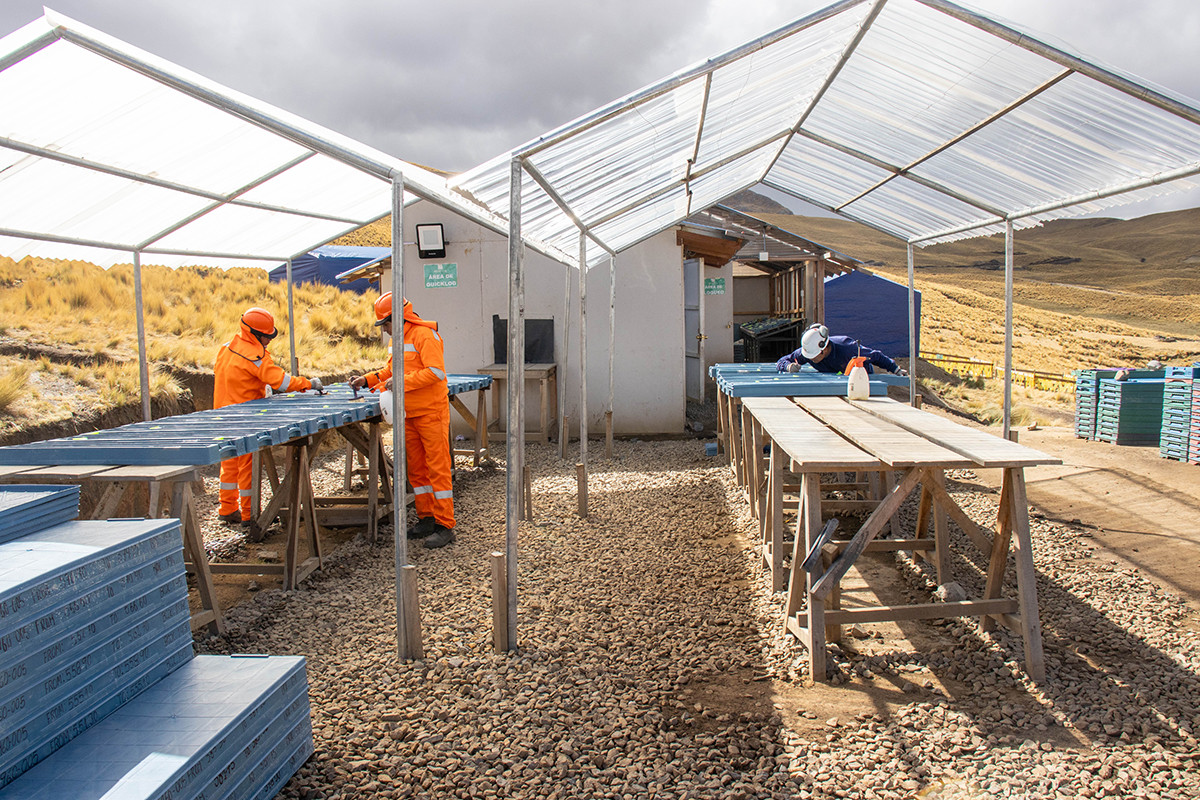
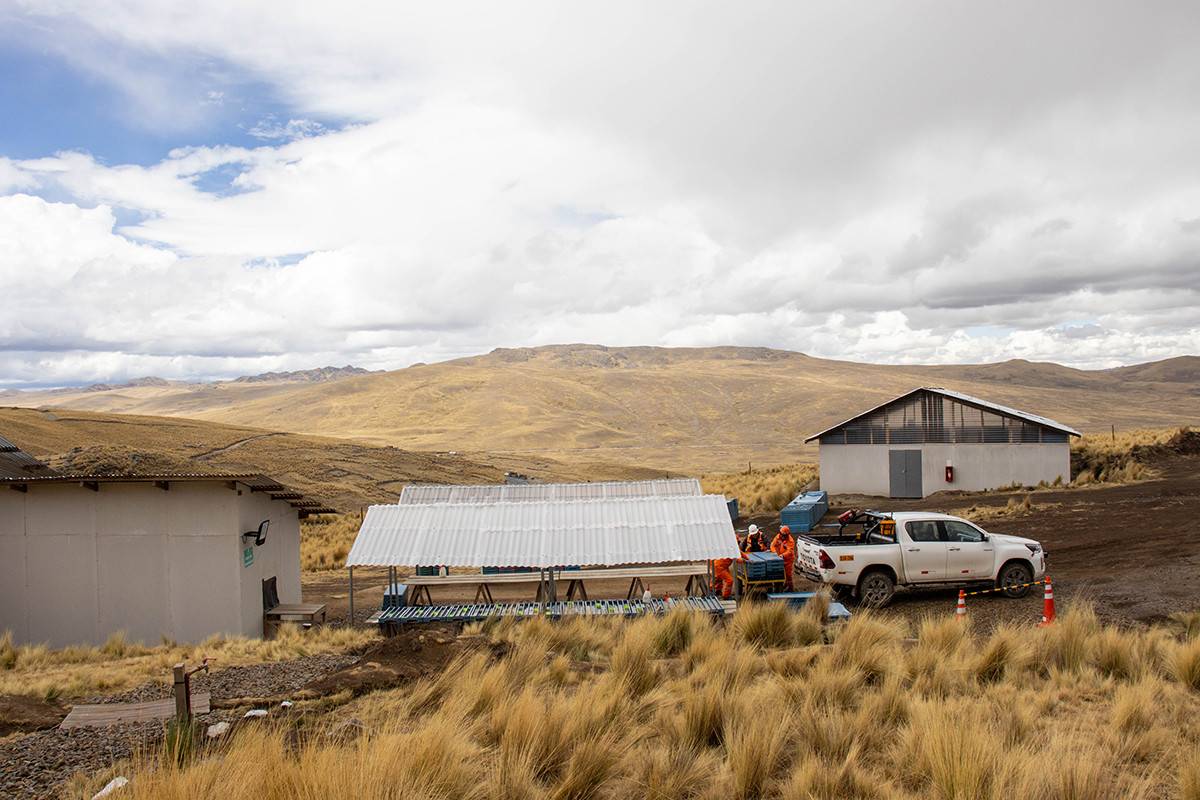
Khaleesi Core Photos
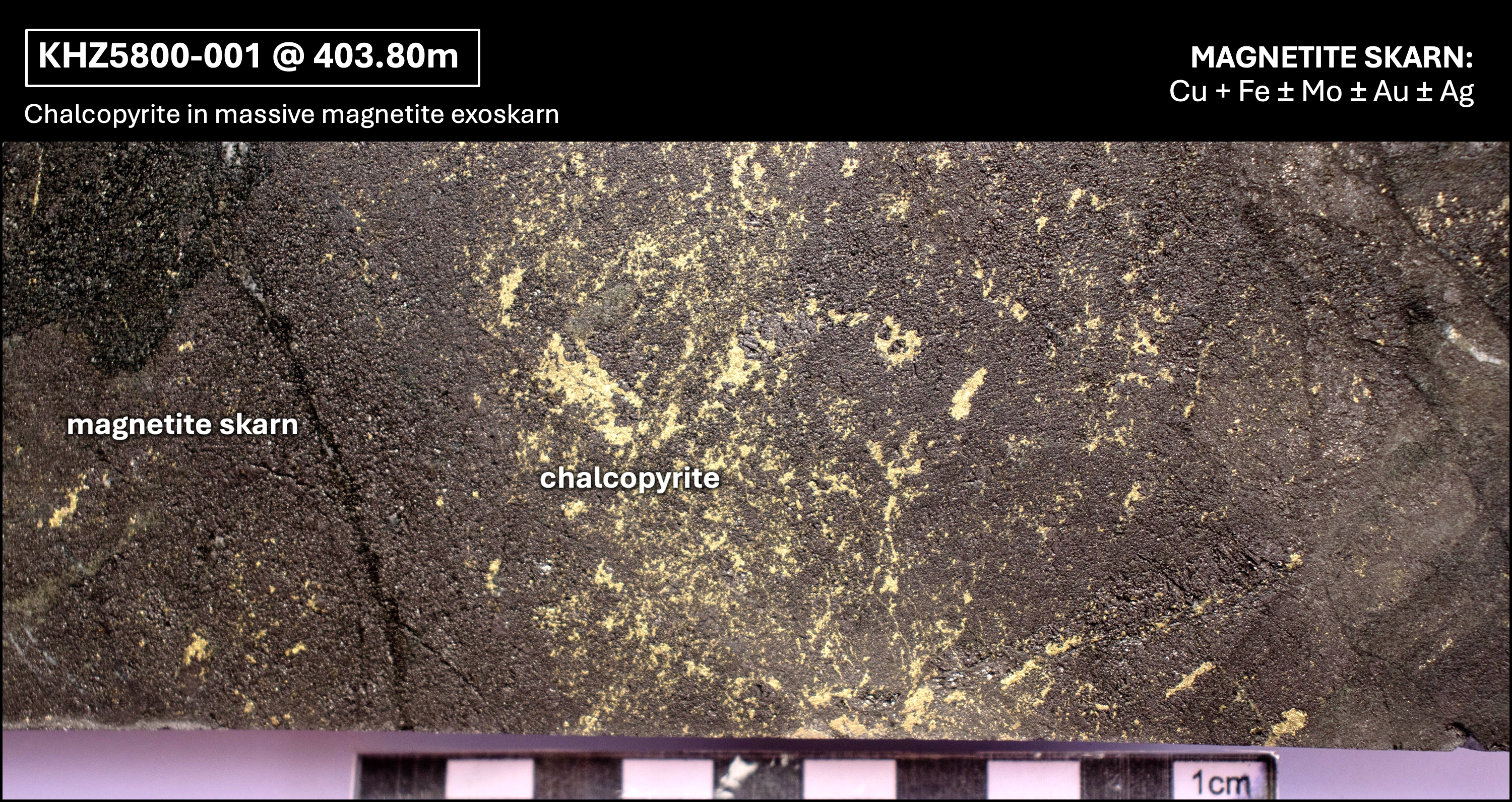
MAGNETITE SKARN: Cu + Fe ± Mo ± Au ± Ag
KHZ5800-01 @ 403.80m: Chalcopyrite in massive magnetite exoskarn
Sample P016291 from 401.7m to 404.1m = 0.44% Cu, o.024 g/t Au, 1.35 g/t Ag, 31ppm Mo and 18.6% Fe
Within 269.00m (from 346.00m to 615.00m) of 0.38% CuEq* (0.30% Cu, 0.037 g/t Au, 1.50 g/t Ag and 65ppm Mo)
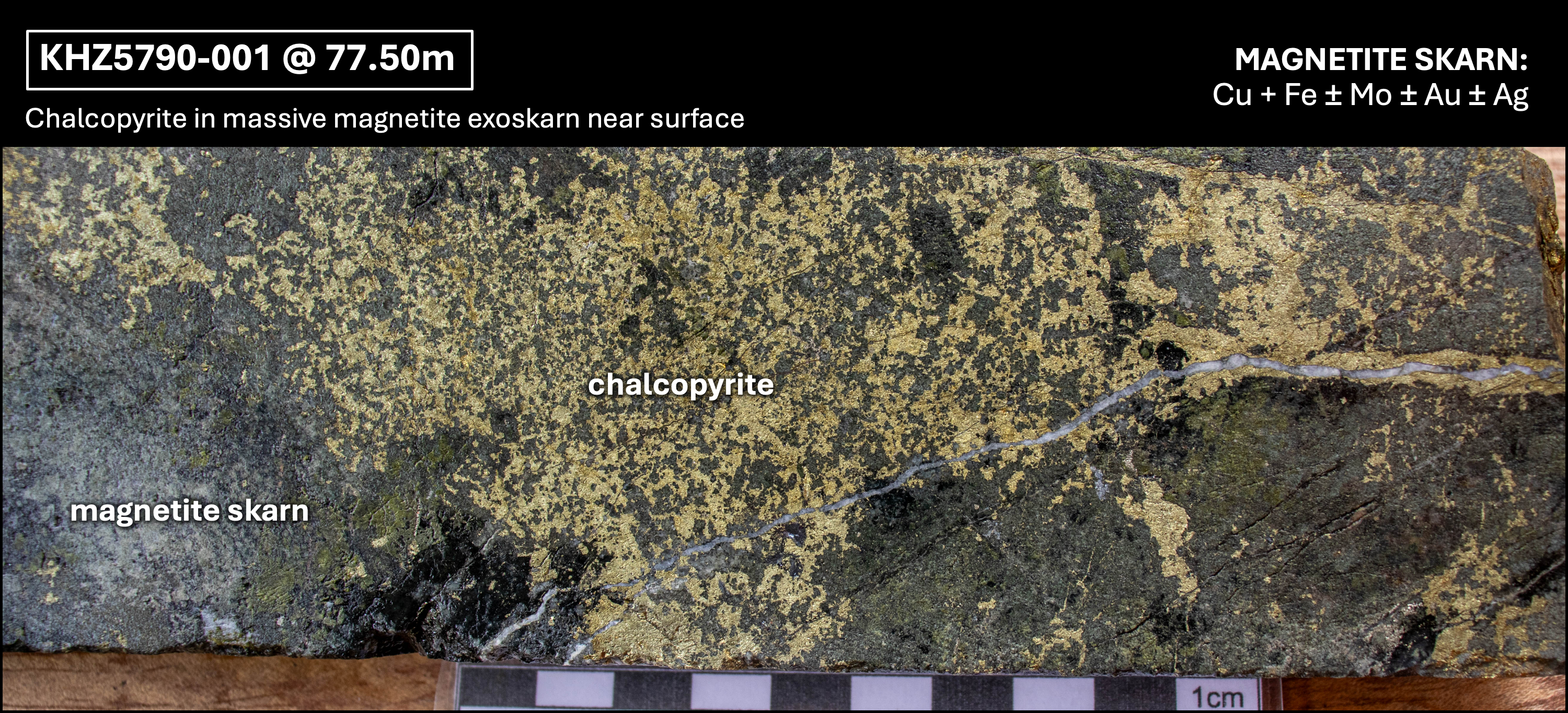
MAGNETITE SKARN: Cu + Fe ± Mo ± Au ± Ag
KHZ5790-001 @ 77.50m : Chalcopyrite in massive magnetite exoskarn near surface
Sample P018664 from 77.1m to 78.5m = 4.91% Cu, 0.419 g/t Au, 17.35 g/t Ag, 164 ppm Mo and 14.3% Fe
Within 43.80m (from 40.10m to 83.90m) of 0.59% CuEq* (0.47% Cu, 0.087 g/t Au, 2.17 g/t Ag and 48 ppm Mo)
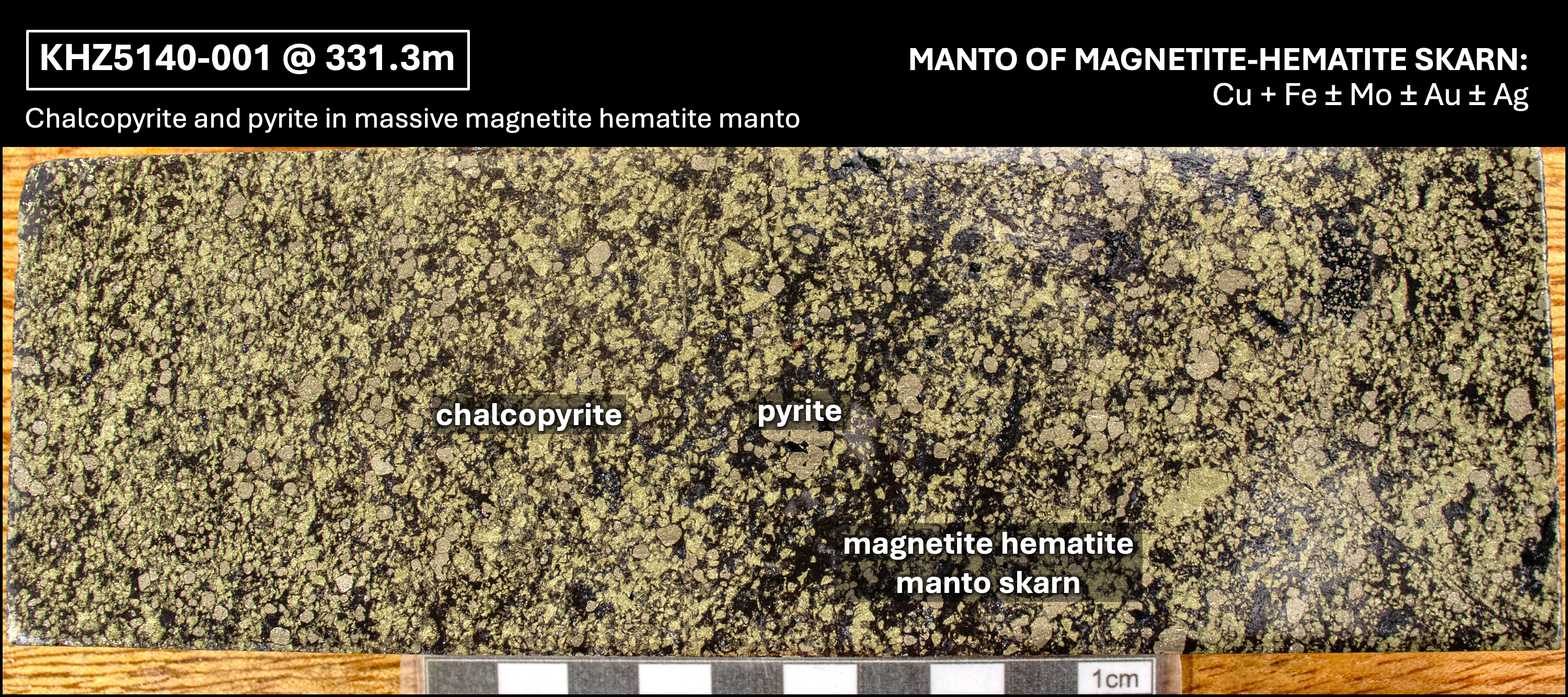
MANTO OF MAGNETITE-HEMATITE SKARN: Cu + Fe ± Mo ± Au ± Ag
KHZ5140-001 @ 331.3m : Chalcopyrite and pyrite in massive magnetite hematite manto
Sample K376693 from 330.00m to 332.10m = 4.21% Cu, 0.111 g/t Au, 6.64 g/t Ag, 2 ppm Mo and 47% Fe
Within 4.20m (from 327.90m to 332.10m) of 3.16% CuEq* (2.97% Cu, 0.154 g/t Au, 4.92 g/t Ag and 2 ppm Mo)
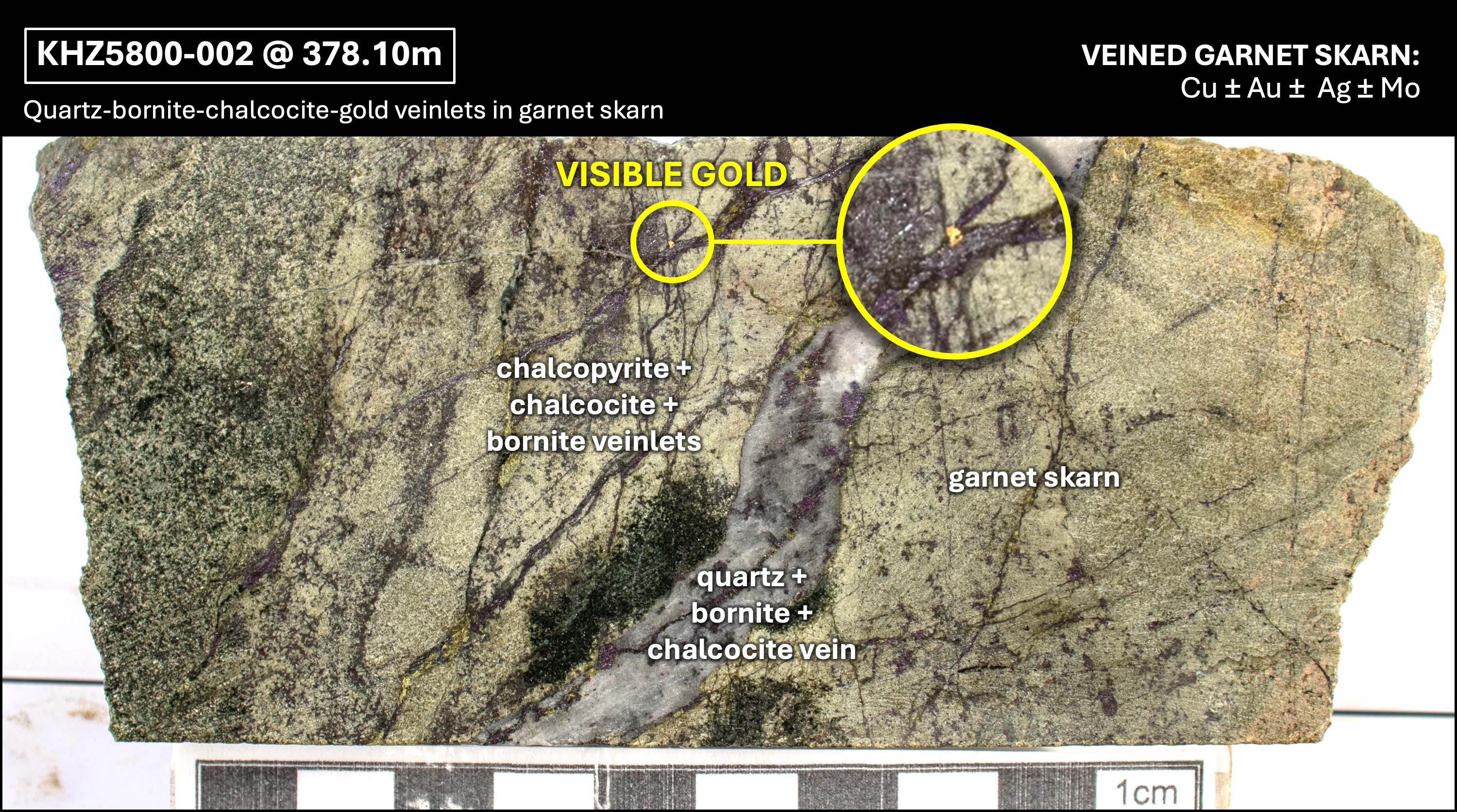
VEINED GARNET SKARN: Cu ± Au ± Ag ± Mo
KHZ5800-002 @ 378.10m : Quartz-bornite-chalcocite-gold veinlets in garnet skarn
Sample P016843 from 376.70m to 378.70m = 1.31% Cu, 2.86 g/t Au, 8.03 g/t Ag and 10 ppm Mo
Within 51.10m (from 339.60m to 390.70m) of 0.84% CuEq* (0.54% Cu, 0.31 g/t Au, 6 ppm Mo and 3.21 g/t Ag)
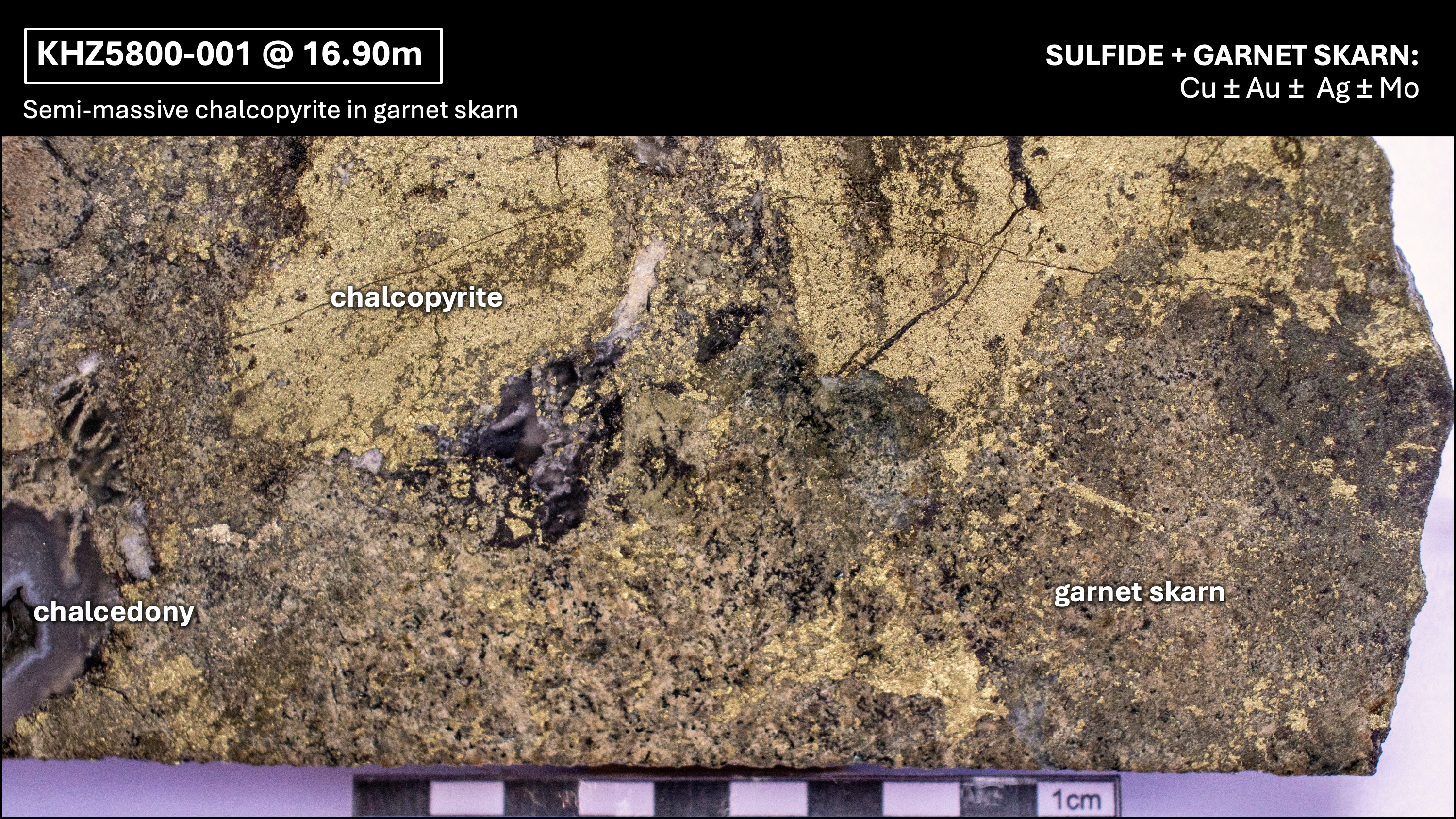
SULFIDE + GARNET SKARN: Cu ± Au ± Ag ± Mo
KHZ5800-001@ 16.90m : Semi-massive chalcopyrite in garnet skarn
Sample P016091 from 16.65m to 17.70m = 6.28% Cu, 0.535 g/t Au, 37.7 g/t Ag and 101 ppm Mo
Within 4.00m (from 15.70m to 19.70m) of 2.33% CuEq* (2.03% Cu, 0.171 g/t Au, 12.14 g/t Ag and 28 ppm Mo)
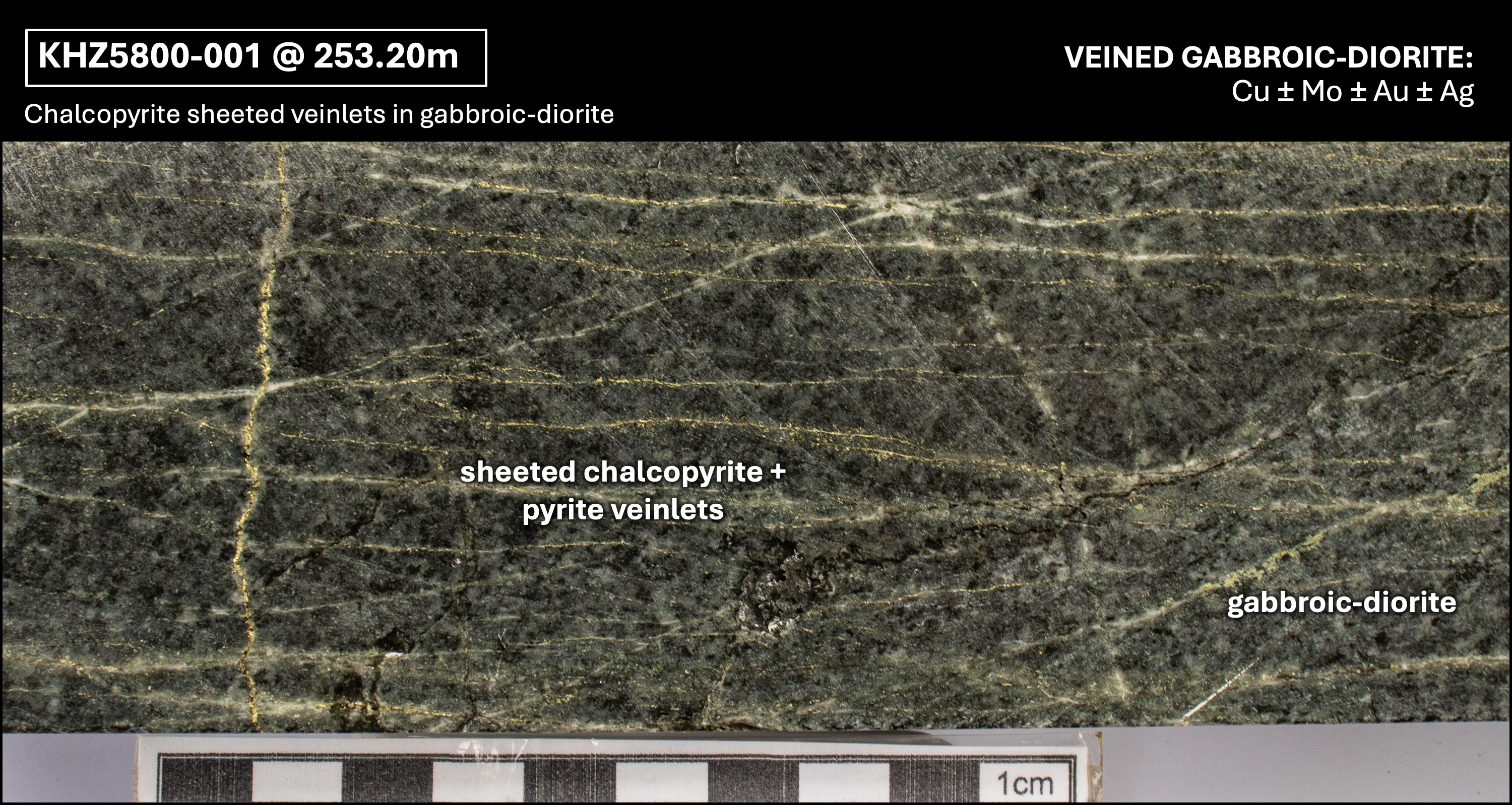
VEINED GABBROIC-DIORITE: Cu ± Mo ± Au ± Ag
KHZ5800-001 @ 253.20m : Chalcopyrite sheeted veinlets in gabbroic-diorite
Sample P016205 from 252.20m to 254.20m = 0.37% Cu, 0.028 g/t Au, 1.53 g/t Ag and 12 ppm Mo
Within 20.00m (from 252.20 to 272.20m) of 0.37% CuEq* (0.32% Cu, 0.037 g/t Au, 1.08 g/t Ag and 28 ppm Mo)
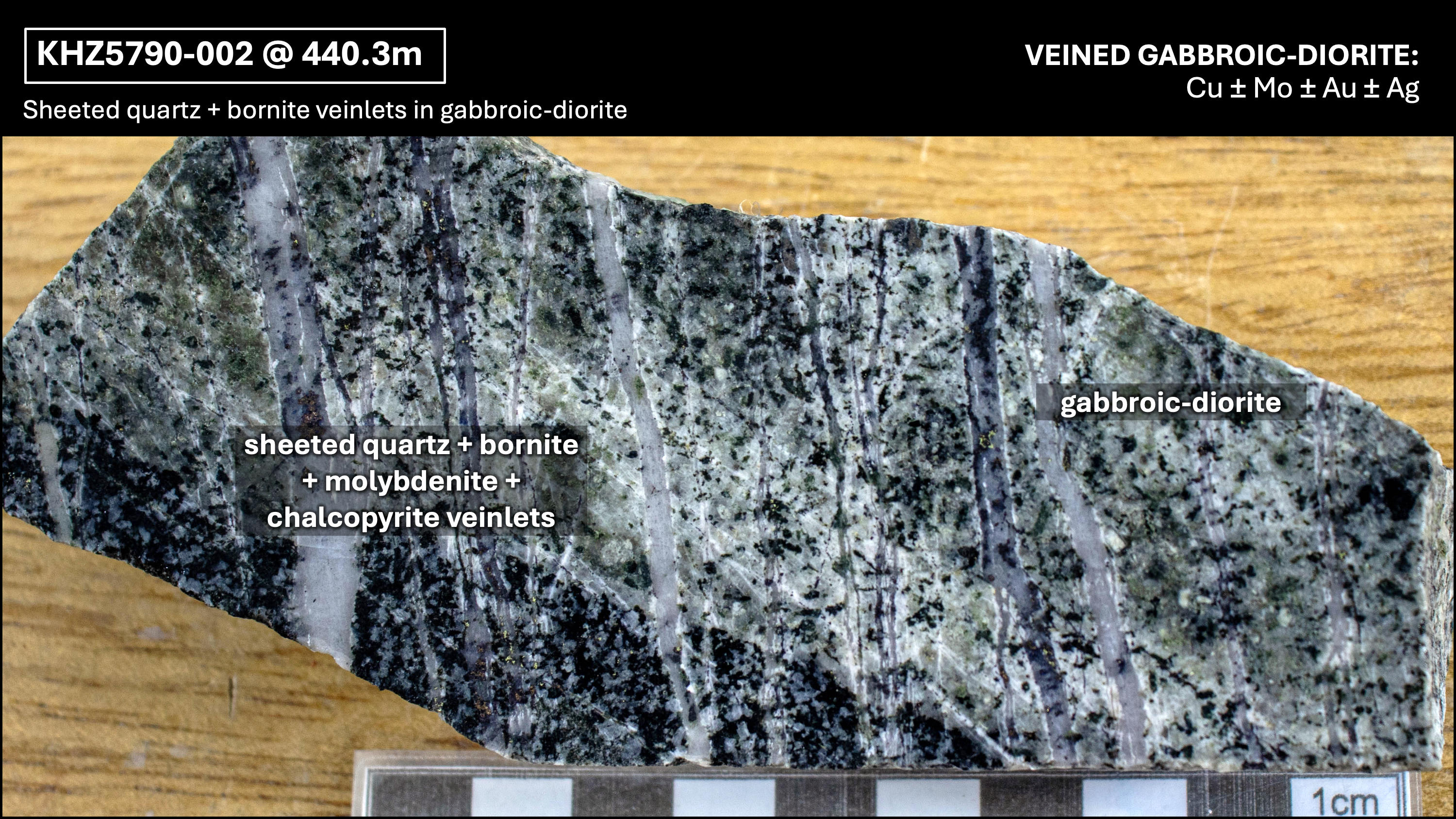
VEINED GABBROIC-DIORITE: Cu ± Mo ± Au ± Ag
KHZ5790-002 @ 440.3m : sheeted quartz + bornite veinlets in gabbroic-diorite
Sample K375253 from 440.30m to 442.20m = 0.64% Cu, 0.066 g/t Au, 1.64 g/t Ag and 13 ppm Mo
Within 22.90m (from 432.20m to 455.10m) of 0.35% CuEq* (0.33% Cu, 0.034 g/t Au, 0.89 g/t Ag and 12 ppm Mo)
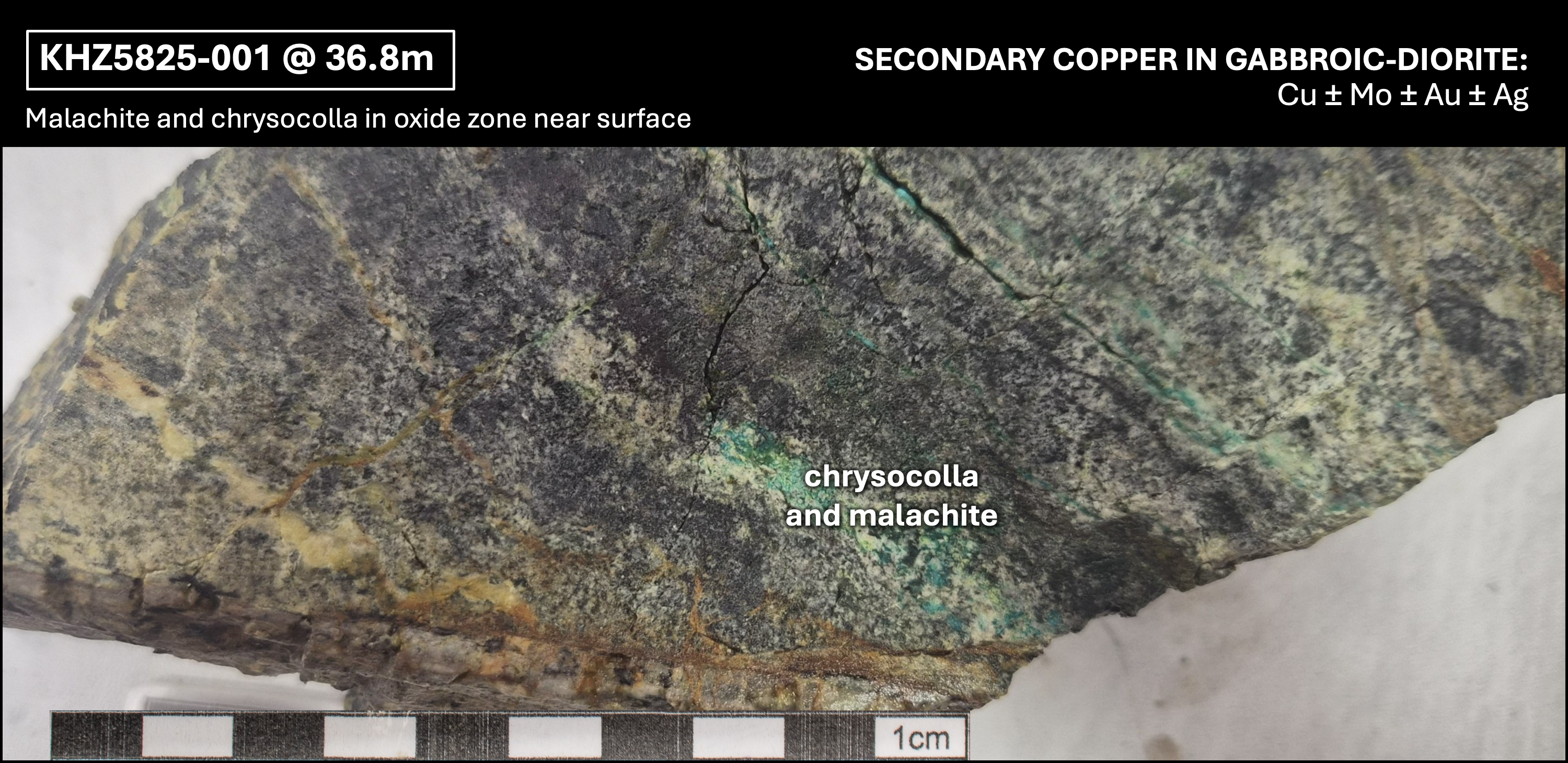
SECONDARY COPPER IN GABBROIC-DIORITE: Cu ± Mo ± Au ± Ag
KHZ5825-001 @ 36.8m : malachite and chrysocolla in oxide zone near surface
Sample P017466 from 36.6m to 38.6m = 0.67% Cu, 0.147 g/t Au, 1.80 g/t Ag and 204 ppm Mo
Within 101.10m (from 23.40m to 124.50m) of 00.37% CuEq* (0.30% Cu, 0.045 g/t Au, 0.84 g/t Ag and 47 ppm Mo)
Note:
*Copper Equivalent (CuEq) for drill intersections is calculated based on three-year trailing average for each commodity (2023, 2024 and 2025) which equates to US$ 4.18/lb Cu, US$ 2,600/oz Au, US$ 30.54/oz Ag and US$ 21.46/lb Mo, with 80% metallurgical recoveries assumed for all metals. The formula is: CuEq % = Cu % + (0.907 x Au g/t) + (0.0107 x Ag g/t) + (0.00051 x Mo ppm). Since it is unclear what metals will be the principal products and as Khaleesi is an early-stage greenfield project with no metallurgical test work completed, assuming different recoveries is premature at this stage. As such an 80% recovery rate is justified.
Composite intervals are calculated using length weighted averages based on a combination of lithological breaks and copper assay values according to a 0.15% Cu cutoff and include a maximum of 12 meters of internal dilution. All intervals reported are down hole core lengths. True thicknesses have yet to be determined. Mineral resource modelling is required before true thicknesses can be estimated.
Geology
Khaleesi lies in the same porphyry–skarn corridor as Las Bambas and Constancia. Mapping confirms an extensive prograde and retrograde skarn system (~1,200 m × 1,000 m) with chalcopyrite-bornite mineralization, epithermal quartz-sulphide veins traced over ~2,000 m, and porphyry-style alteration in diorite dykes and stocks. A thin glacial till (generally <1–15 m) covers ~1.3 km² of the central area, likely concealing the connection between the skarn and porphyry centers indicated by geophysics.
Khaleesi is along the western edge of the batholith-limestone (Ferrobamba Formation) contact, whereas Jasperoide is at the edge of a large limestone inlier.
I agree to and consent to receive news, updates, and other communications by way of commercial electronic messages (including email) from C3 Metals Inc. I understand I may withdraw consent at any time by clicking the unsubscribe link contained in all emails from C3 Metals Inc.
C3 Metals Inc.
161 Bay Street,
27th Floor,
Toronto, ON
Canada, M5J 2S1 info@C3Metals.com